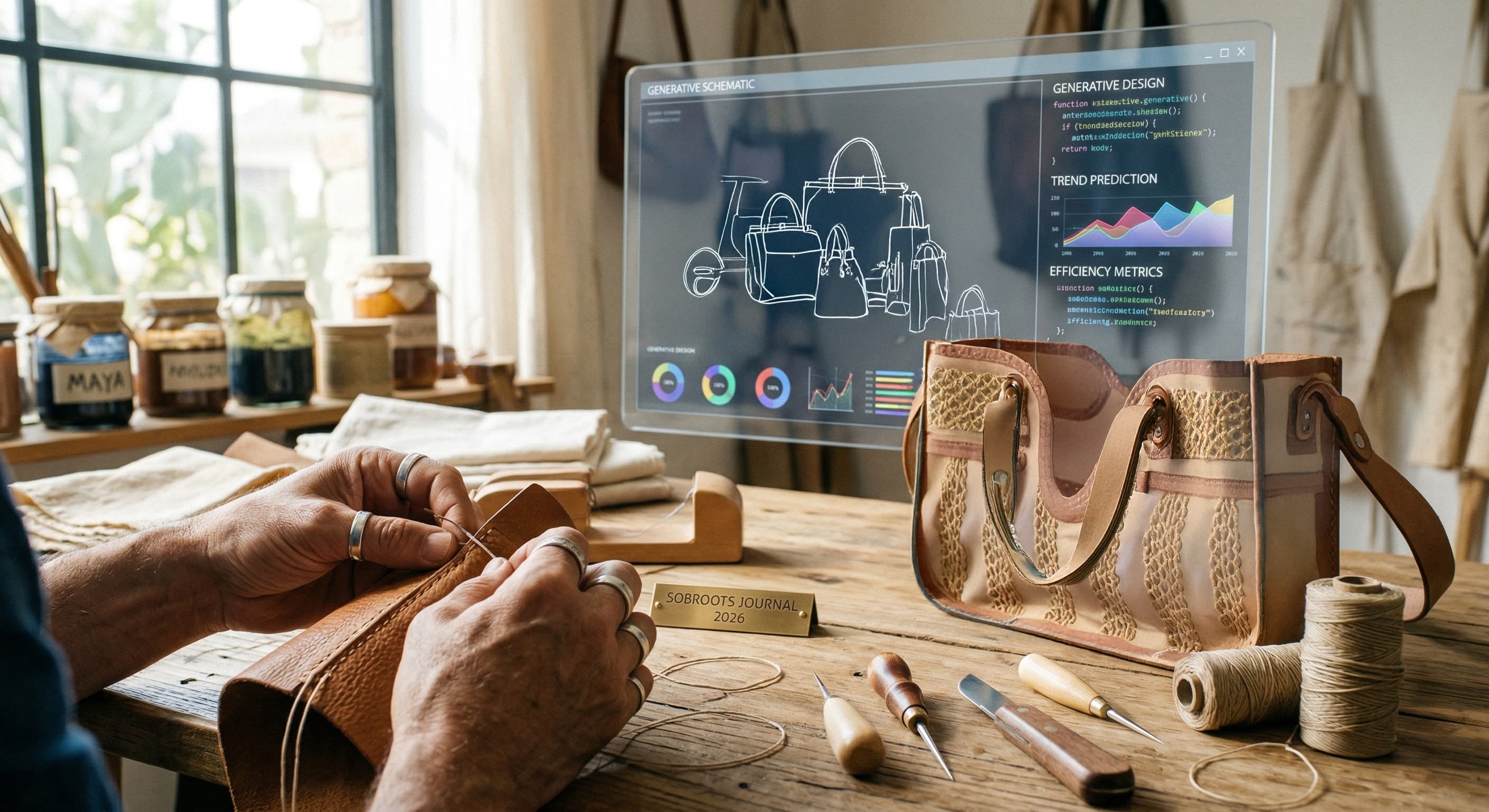
According to McKinsey, 70% of ready-to-wear brands have integrated AI into their design processes. So as the algorithm's voice grows louder, why is the value of handcraft rising?
According to McKinsey's annual State of Fashion report, co-produced with Business of Fashion, seventy percent of the world's leading ready-to-wear companies have now integrated artificial intelligence into their design processes. An algorithm generates thousands of collection proposals in seconds. Another piece of software scans TikTok and Pinterest images to predict the next trend. The Global Fashion Summit this year in Copenhagen was built around a single question: Have we reached the end of speed?
The answer comes from a quieter place than you might expect.
While the Algorithm Designs, Hands Begin to Speak
AI's entry into fashion has been faster than predicted. A collection's draft can now be produced in hours using AI-assisted tools; colour palettes are determined by market data, fabric choices guided by climate and logistics analysis. Large brands describe this transformation as efficiency.
But efficiency is not value.
And indeed, an interesting counter-current is observable in the market. The global second-hand clothing market is set to grow two to three times faster than the primary market over the next two years. As customers turn their backs on algorithm-predicted collections, they are increasingly drawn to pieces that are more original, produced in smaller numbers, and carry a story. As the market climbs, demands are shifting direction: Less. But real.
In the Crowd of Mass Production, Authenticity Became the New Luxury
A generation ago, luxury was measured by price. Today the coordinates of luxury have shifted. Research shows that among urban, educated female consumers over 30, three factors are decisive in purchasing decisions: limited production, handcraft, and emotional connection to the brand's story.
These are precisely the three things missing from AI-generated design.
A machine can calculate the form of a bag. But it cannot calculate the trace of the hands that turn that form into reality, the decision behind every stitch, or the moment of saying let me do this differently this time. This is why boutique and atelier brands worldwide are gaining unexpected visibility amid the noise of mass production.
The Materials Revolution: Natural, Sustainable, Long-Lasting
Another headline shaping the 2026 agenda of Global Fashion Agenda and similar platforms: deep-tech materials. Vegan alternative surfaces produced from mushroom mycelium, materials derived from apple peel, recyclable threads free of harmful chemicals.
In European markets, sustainable production has moved beyond being an ethical preference and become a purchasing criterion. France and other EU countries have begun requiring fashion companies to declare their environmental impact. Consumers continue asking where things come from.
This development is transforming not just production processes but narrative form. A bag's raw material, how it was produced, how many hands it passed through, and how long it will last — these are no longer background information but a piece as important as the product itself.
The Philosophy of Making Less, Lasting Longer Is Becoming a Global Language
Slow fashion had long been cited as an ethical choice. In 2026, this concept has broken into the mainstream.
The most defining statement in Business of Fashion's State of Fashion report this year: The fashion industry needs a new growth playbook. The old model built on speed and volume has stalled. The model replacing it puts authenticity, permanence, and building a deep relationship with the customer at the forefront.
Limited collections. Waiting lists. A product page with a history for every piece. Moments where the customer feels not just a buyer, but part of a choice.
This is the complete opposite of mass production. And for exactly this reason, it has become a genuine competitive advantage today.
The Roots Are Stronger Than Ever
It does not matter how many collection proposals a design software generates.
What matters is what you feel when you first hold that bag. What you want to say together with the piece you carry on your shoulder as you walk through a city. The design that is not in everyone's hands, that gains meaning alongside you.
In this era when AI is rewriting fashion, every piece that carries the trace of human hands is quietly rising in value.
Because what is real is always noticed.
Every collection is made in small numbers. What is leaving the workshop right now.